








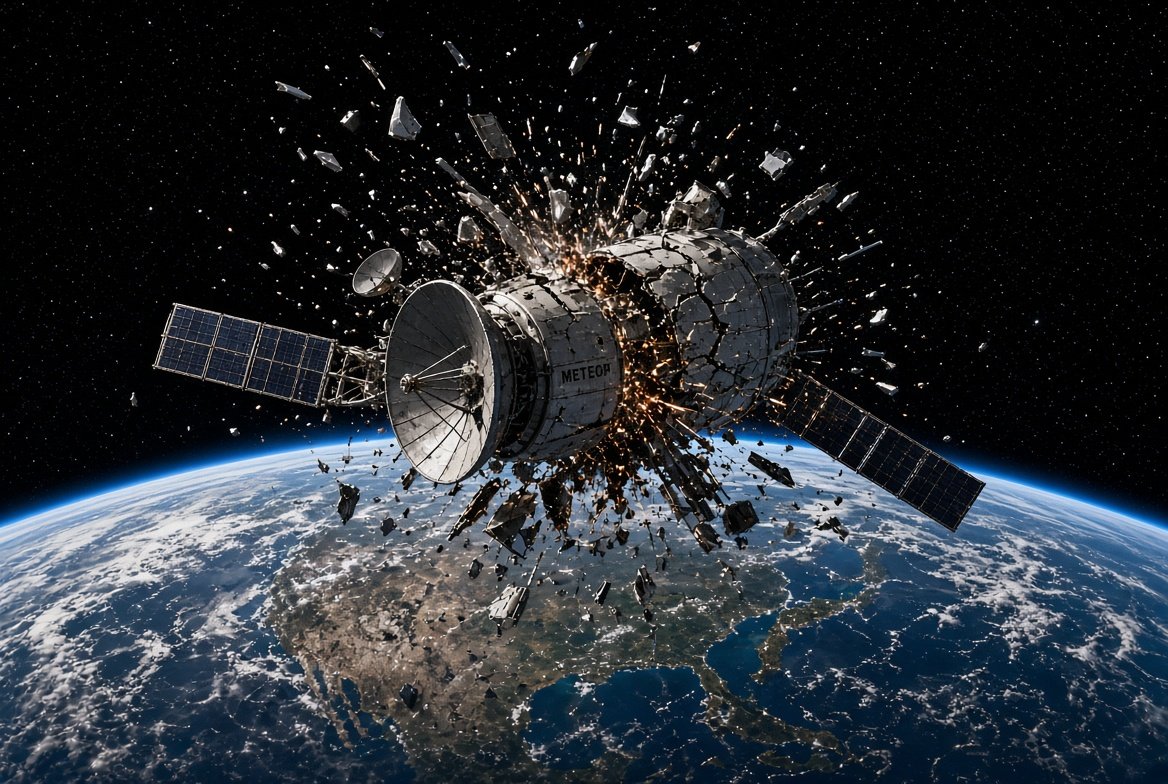
A 45-year-old Soviet satellite just broke apart high above Earth, scattering tens of new fragments into one of the busiest orbital highways. This isn’t an isolated glitch. It’s the latest signal that low Earth orbit is getting riskier, faster.
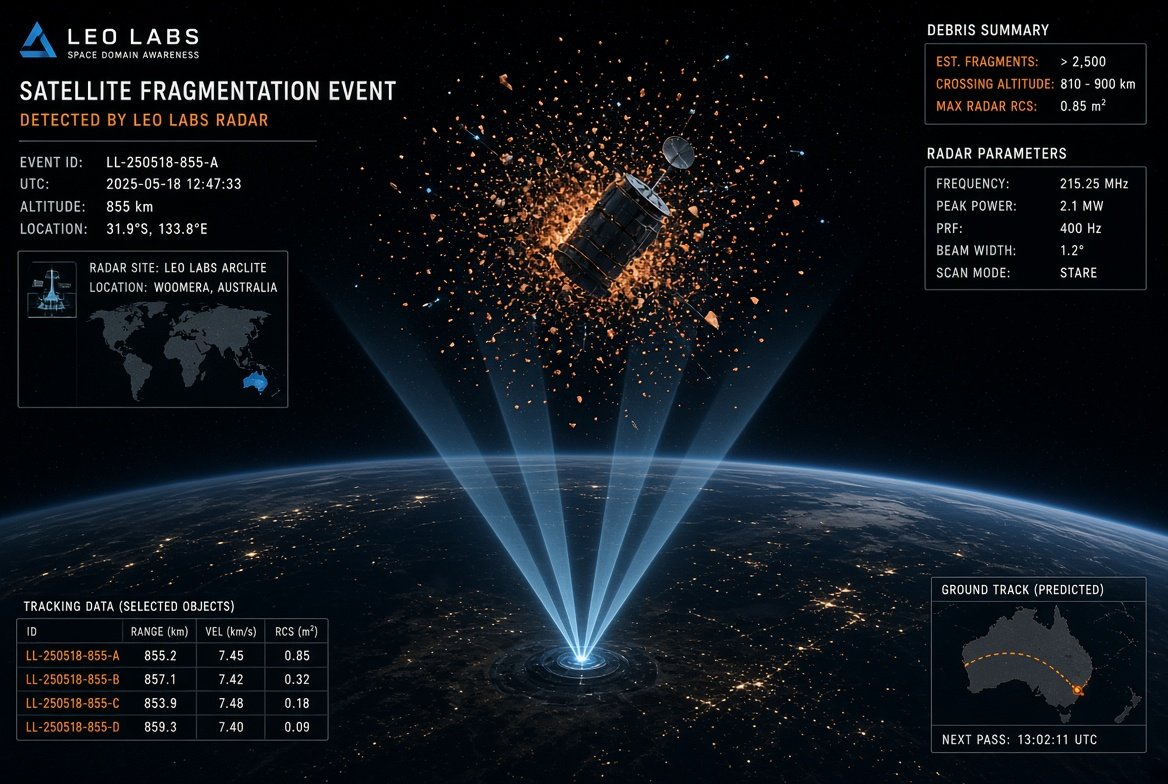
On or around October 5, 2026, the long-dead Meteor 2-7 (NORAD ID 12456) fragmented while passing over Western Australia. Commercial tracking firm LeoLabs detected the “debris-generating event” with its radar network. Follow-up observations confirmed an estimated tens of new pieces near the satellite’s position at roughly 855 kilometers (about 530 miles) altitude — a zone already packed with debris.

Meteor 2-7 launched from Plesetsk Cosmodrome in May 1981 as part of the Soviet Meteor weather-monitoring series. It stopped functioning decades ago but never came down. This is actually the satellite’s second major breakup. It previously fragmented in March 2004. Orbital debris expert Jim Shell noted the latest event occurred in a region where debris density is especially high.
A Pattern, Not a One-Off
LeoLabs called it part of a worrying trend. Over the previous six months the company tracked multiple fragmentation events: the Cold War-era U.S. reconnaissance satellite USA 32 in September 2026, a Chinese rocket body in late August, an earlier Starlink anomaly, and a Russian inspector satellite in January (though that one was higher up in geostationary orbit).
These incidents don’t all share the same cause — some may stem from residual propellant, battery failures, or collisions with untracked debris — but the frequency is rising. At orbital speeds of about 7–8 km per second, even a small fragment carries destructive kinetic energy.
The Bigger Picture: Debris Is Climbing Fast
According to the European Space Agency’s latest space environment statistics (updated around October 2026), roughly 47,000 objects are regularly tracked and catalogued by space surveillance networks. That number has grown dramatically from earlier decades. Models estimate far more smaller pieces: around 68,000 objects larger than 10 cm (including active satellites), 1.5 million between 1–10 cm, and hundreds of millions of even tinier fragments.

Objects at Meteor 2-7’s altitude can stay aloft for centuries or longer because atmospheric drag is weak. Every new cloud of debris raises the chance of secondary collisions — the slow-burn version of the Kessler syndrome, where collisions create more debris that triggers still more collisions. ESA’s 2026 reporting has highlighted that even without new launches, the existing debris population in low Earth orbit is expected to keep growing through collisions alone in some altitude bands.
Why This Hits Home Now
Today’s low Earth orbit hosts thousands of active satellites, including massive constellations that deliver internet, Earth observation, and weather data. Operators already perform frequent collision-avoidance maneuvers. Adding more untracked or newly generated fragments increases the workload, the fuel cost, and the residual risk.
The Meteor 2-7 event itself is not the start of a runaway cascade. But it is a clear reminder: aging, uncontrolled spacecraft left in valuable orbits are ticking time bombs. Better tracking (exactly what companies like LeoLabs provide), stricter post-mission disposal rules, and eventual active debris removal are no longer optional niceties — they are becoming operational necessities.
What Happens Next
LeoLabs and government catalogs (including U.S. Space Force tracking via Space-Track.org) will continue refining the new fragment orbits. Most of the pieces will likely remain in similar altitude bands for a long time. No immediate widespread threat to specific active satellites has been publicly flagged, but the cumulative effect of these events is what keeps debris analysts up at night.
Space is no longer the empty frontier it once seemed. Every shattered relic from the Cold War era makes the modern orbital environment a little more crowded — and a little less forgiving.
Key takeaways for readers and searchers:
- Soviet satellite breakup 2026 / Meteor 2-7 fragmentation
- LeoLabs detects new orbital debris
- Space debris crisis low Earth orbit
- Kessler syndrome risk update
- Aging satellites breaking apart in orbit
Stay tuned as tracking data matures. The sky above us is getting busier every month — and the debris problem is no longer theoretical.