







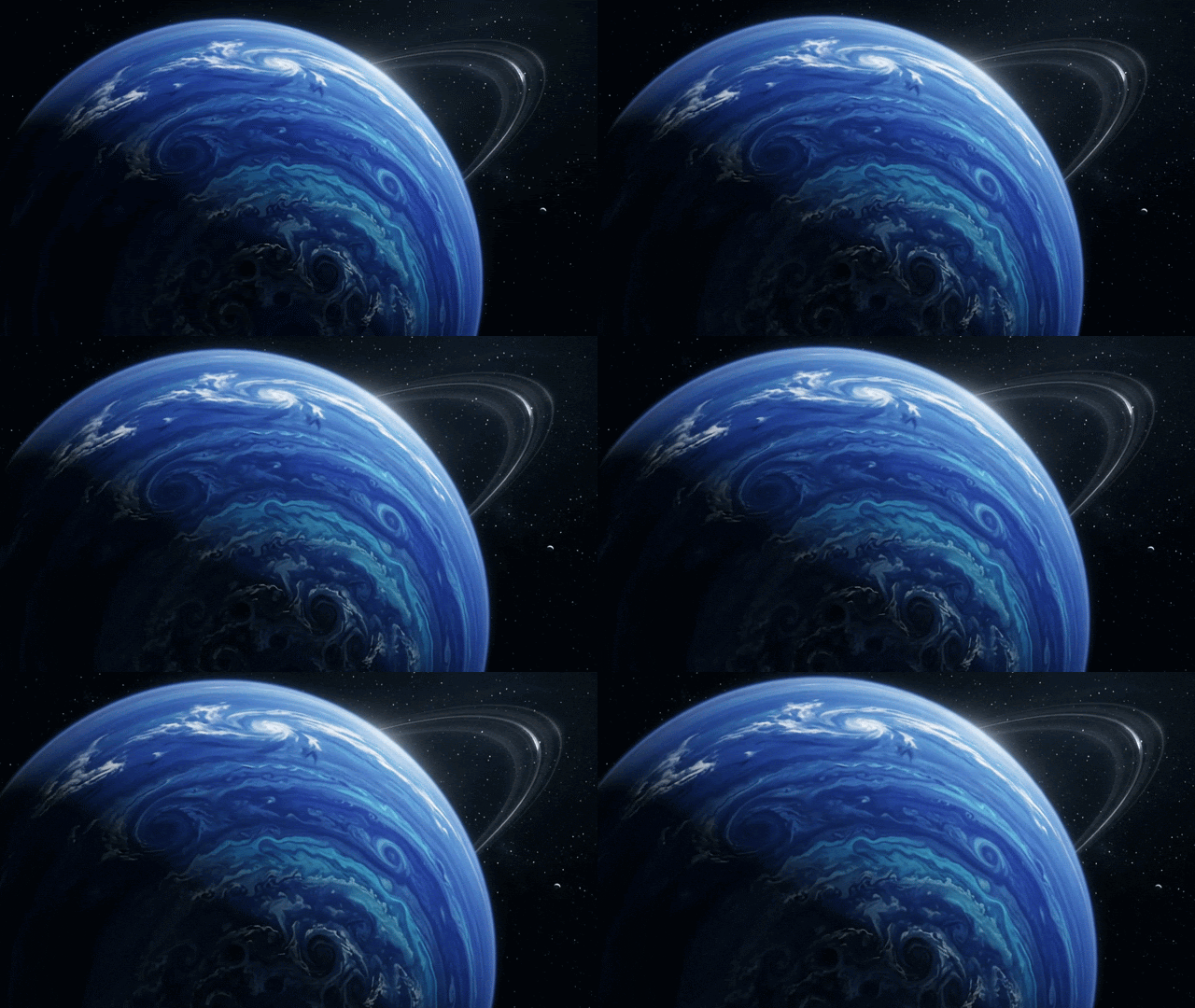
More than 37 years after humanity’s only close encounter with the outermost major planet in our solar system, archival spacecraft data has been transformed into a breathtaking cosmic portrait. A newly featured composite image brings to life a Voyager 2 rare view of Neptune, showcasing the distant ice giant, its largest moon, and its delicate ring system from an angle that has never been seen since.
A Look Back at the Historic Voyager 2 Neptune Flyby 1989
On August 25, 1989, NASA’s Voyager 2 spacecraft swept past Neptune, completing the only close-up reconnaissance of the planet in human history. As the probe hurtled away from the Neptunian system and looked back toward the Sun, its cameras recorded a hauntingly beautiful farewell scene.
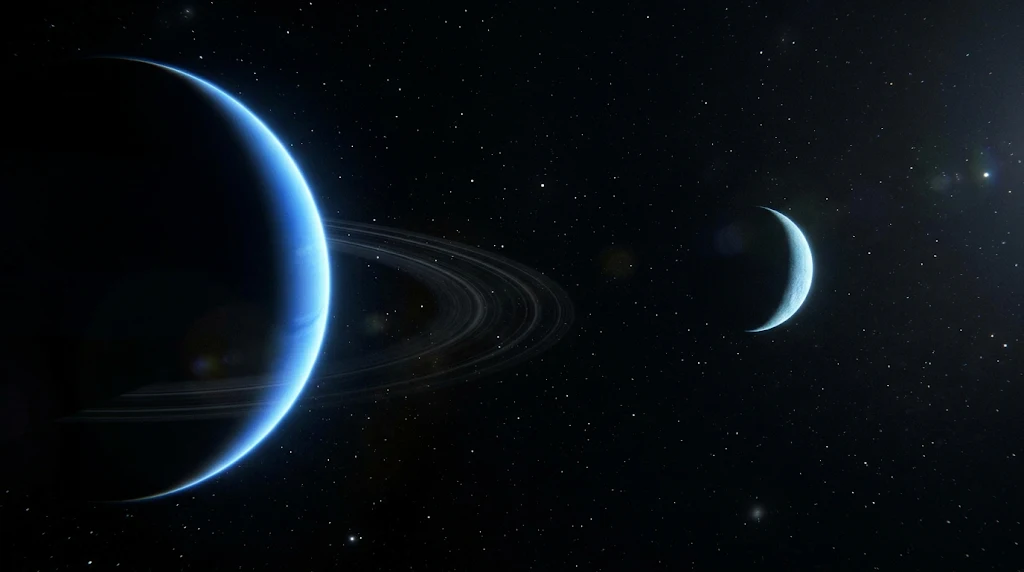
Using original data from the NASA Planetary Data System, astrophotographer Rolf Olsen assembled and processed a striking NASA Voyager 2 Neptune composite. Featured as NASA’s Astronomy Picture of the Day on November 21, 2026, this visual reconstruction bridges raw scientific observations with careful modeling to recreate exactly what the departing spacecraft saw as Neptune faded into the dark.
Why This Neptune Crescent View From Space Is Impossible From Earth
From telescopes on Earth, astronomers only ever observe Neptune fully illuminated from its Sun-facing side. Because Neptune orbits roughly 2.8 billion miles (4.5 billion kilometers) from the Sun, we can never get behind it to see its night side.
However, by traveling past the planet, Voyager 2 captured a Neptune crescent view from space. In the composite, both Neptune and its moon Triton appear as razor-thin arcs of sunlight suspended against the pitch-black void. This backlit geometry does more than create dramatic lighting—it illuminates subtle atmospheric hazes and dust particles that are virtually invisible from Earth.
Uncovering Neptune South Pole Atmospheric Storms and Elusive Rings
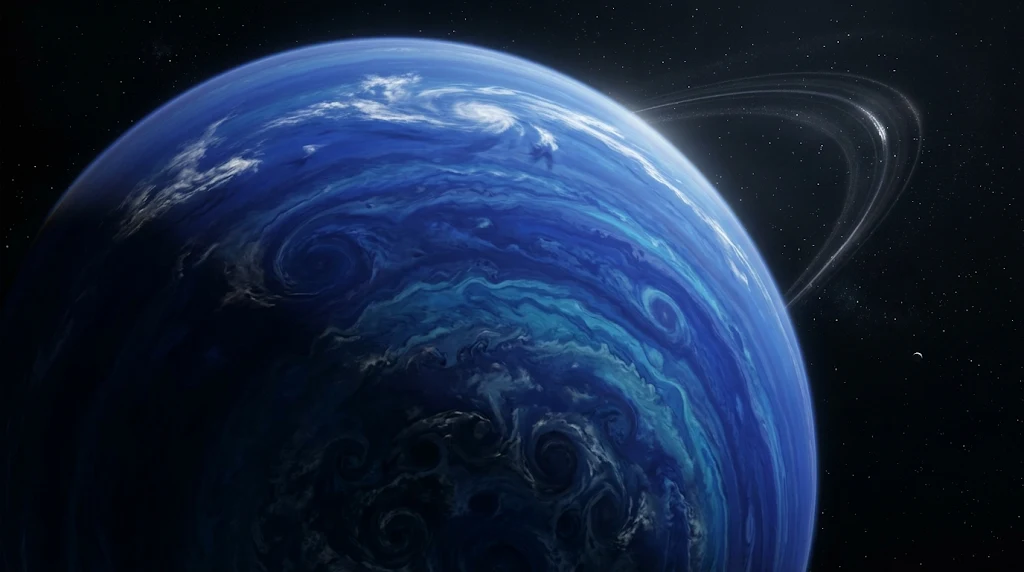
The reconstructed imagery draws attention to two of Neptune’s most fascinating features: its violent weather and its shadowy ring system.
-
Extreme Weather: Even at the frigid edge of the solar system, Neptune south pole atmospheric storms rage with astonishing intensity. The view reveals high-altitude, wispy cirrus-like clouds, a dark band encircling the southern polar region, and a swirling cloudy vortex hovering over the pole. Fueled by an internal heat source, Neptune’s hydrogen, helium, and methane atmosphere generates the fastest sustained winds in the solar system—clocking in at over 1,200 miles per hour (1,900 kilometers per hour).
-
Backlit Ring Arcs: The 1989 mission confirmed that Neptune is surrounded by Neptune faint rings and Triton, including three unusually dense, bright “ring arcs.” Because parts of these dusty rings were too dim to register clearly in single raw frames, Olsen incorporated modeled segments into the composite to present a scientifically grounded, complete visualization of the ring plane.
Triton Retrograde Orbit and Geysers in a Starry Farewell
Floating beyond Neptune’s crescent is Triton, the planet’s largest moon and one of the strangest worlds in the outer solar system. Scientists have long been fascinated by Triton retrograde orbit and geysers:
-
A Captured World: Unlike most large moons, Triton orbits in the opposite direction of Neptune’s rotation. This backward path strongly indicates that Triton did not form alongside Neptune, but was instead a Kuiper Belt object captured by the giant planet’s gravity.
-
Cryovolcanic Activity: Despite surface temperatures plunging below -390°F (-235°C), Voyager 2 spotted active geysers erupting plumes of nitrogen gas across Triton’s icy crust.
To anchor the scene in reality, the background starfield maps roughly 7.5 degrees of sky centered on the constellation Camelopardalis—the exact direction Voyager 2 was gazing as it sped toward the edge of the solar system.
Voyager 2’s Lasting Legacy in Interstellar Space
Having crossed the heliopause in December 2018, Voyager 2 is now traveling through interstellar space. Yet nearly four decades after its flyby, its archive continues to yield fresh visual perspectives. Until a future flagship mission returns to the ice giants, this Voyager 2 rare view of Neptune remains our clearest window into the twilight side of the solar system’s most distant major world.