








You may never personally walk the organic dunes or soar above the liquid methane lakes of Saturn’s largest moon, but your name can. NASA has opened its Send Your Name to Titan (also called Journey to Titan) campaign, inviting the public to become symbolic passengers on the NASA Dragonfly mission — one of the most ambitious planetary exploration efforts of this decade.
Submitted names will be stored on a microchip carried by Dragonfly, a nuclear-powered robotic rotorcraft designed to fly across Titan’s surface. The opportunity is free, open worldwide, and closes at 11:59 p.m. EST on January 15, 2027.
Official signup: https://go.nasa.gov/dragonfly-names
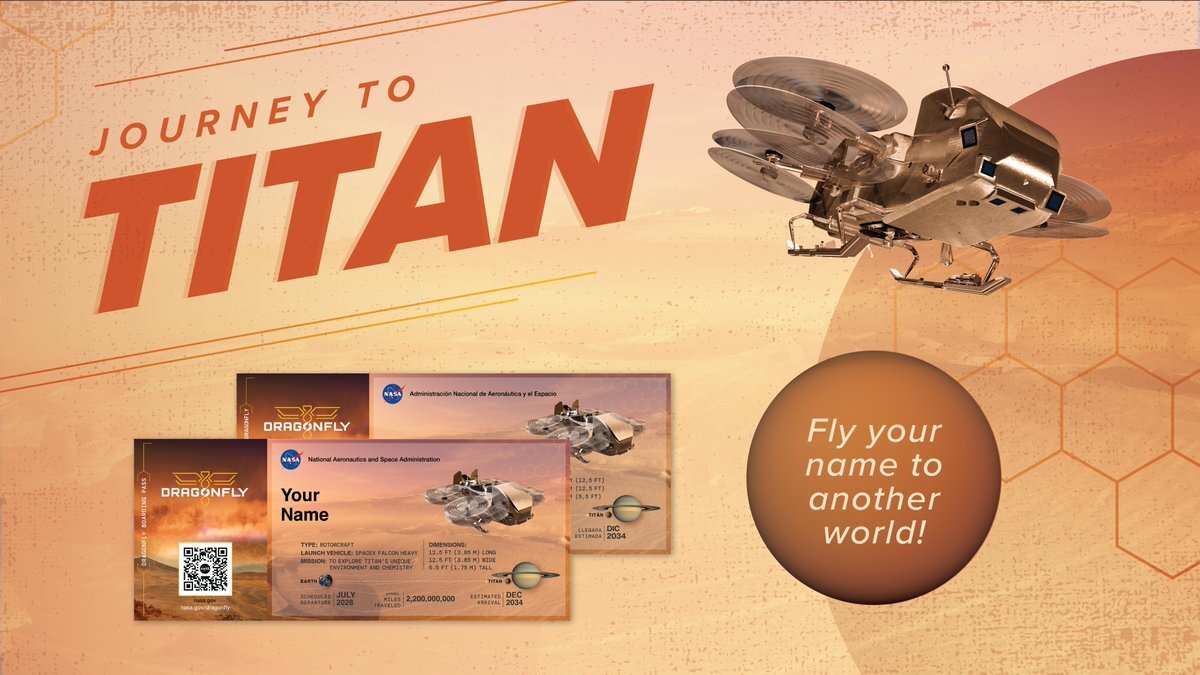
Participants receive a personalized digital boarding pass they can save and share.

What Makes the NASA Dragonfly Mission Unique?
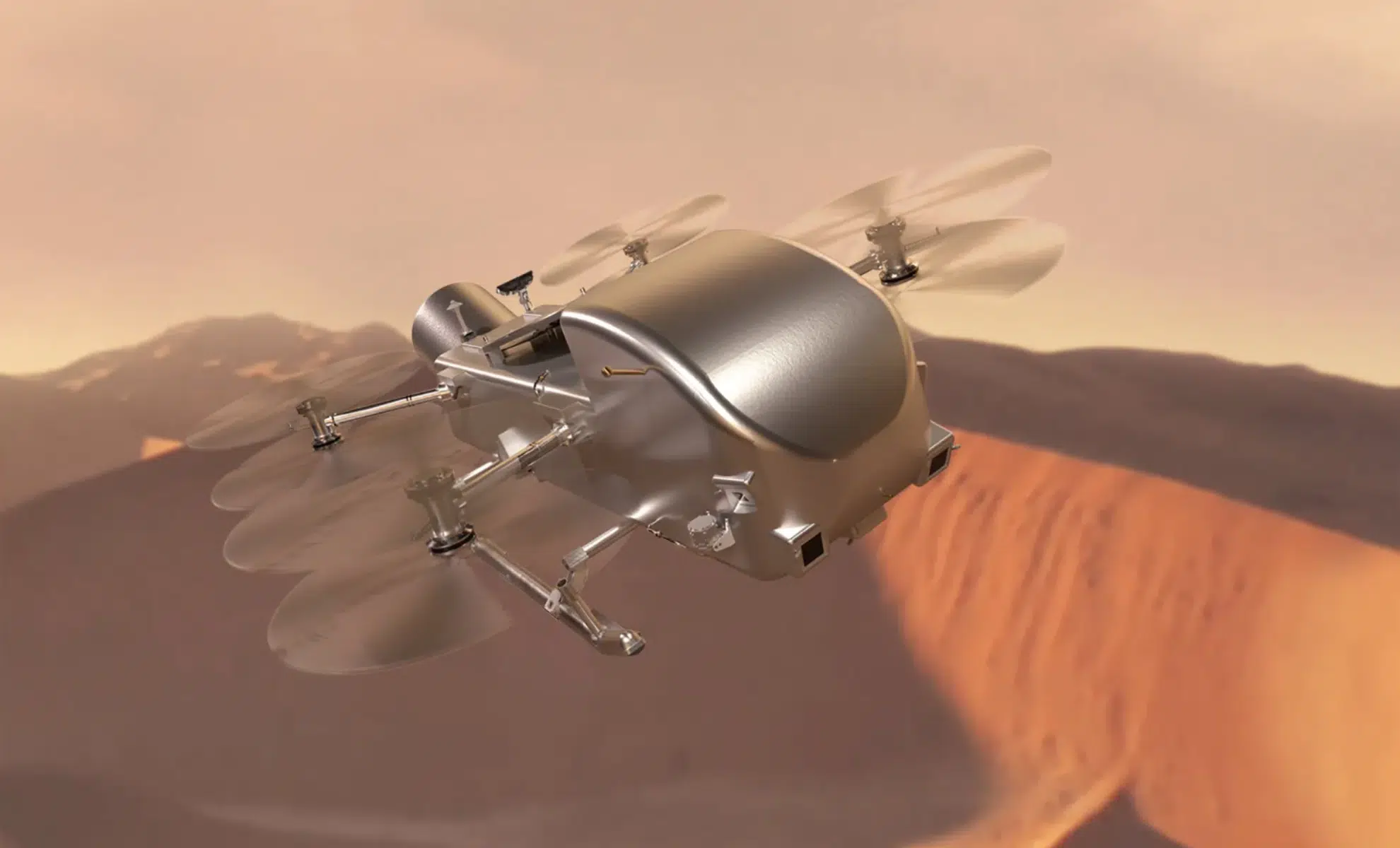
Unlike traditional rovers that stay at one landing site, Dragonfly is the first-ever rotorcraft science mission. It will use eight rotors to hop between locations separated by kilometers, taking advantage of Titan’s dense atmosphere and relatively low gravity.
Also Read many other Space News
Key mission facts:
- Launch: July 2028 on a SpaceX Falcon Heavy from Kennedy Space Center
- Arrival at Titan: 2034
- Power: Radioisotope thermoelectric generator (not solar panels — essential for operating through Titan’s thick haze far from the Sun)
- Primary science phase: About 3.3 years exploring multiple sites
Dragonfly will target Titan’s equatorial dunes (landing area officially named Ahmakiq Undae) and regions near the Selk impact crater, where scientists believe liquid water once mixed with organic materials.
Why Titan Could Reveal Clues About Life’s Origins
Titan is larger than the planet Mercury and is the only moon in the solar system with a thick, nitrogen-rich atmosphere, weather systems, and surface liquids. Temperatures hover around –290°F (–179°C). At these extremes, water ice behaves like rock, while methane and ethane form clouds, rain, rivers, and seas — a cycle similar to Earth’s water cycle but with completely different chemistry.
The atmosphere continuously produces complex carbon-based compounds. Dragonfly’s instruments will analyze these materials to study prebiotic chemistry — the chemical steps that may have preceded life on early Earth. The mission is not designed to find living organisms; it will assess whether Titan has (or once had) environments favorable to the building blocks of life.
How to Send Your Name to Titan
- Visit the official NASA page: https://go.nasa.gov/dragonfly-names
- Enter your name and email.
- Download or save your personalized digital boarding pass.
- Optional: Opt in for mission updates and share on social media tagging @NASASolarSystem.
Over 166,000 people had already signed up shortly after the campaign opened in late October 2026. The deadline is firm: January 15, 2027.
Nicky Fox, NASA’s associate administrator for the Science Mission Directorate, said:
“NASA’s Dragonfly mission will simply blow your mind. By flying the first-ever rotorcraft science mission, NASA will explore Saturn’s largest moon, Titan, as we search for signs of habitability on a distant world that is most similar to our own. We are excited to bring humanity along for the journey of a lifetime.”
The Bigger Picture
This is the latest in NASA’s long tradition of public “send your name” campaigns (previously done for Mars rovers, Artemis, and other missions). While purely symbolic, it connects millions of people to a genuine scientific endeavor that will return data about organic chemistry and habitability on a world roughly a billion miles away.
Dragonfly is currently being assembled and tested at the Johns Hopkins Applied Physics Laboratory. Once it arrives at Titan in 2034, it will conduct repeated flights, sampling diverse environments no previous mission has explored by air.
Don’t wait — the boarding pass window closes January 15, 2027.
Claim your spot: go.nasa.gov/dragonfly-names