







A space telescope has just detected a strange cosmic pattern in high-energy particles that scientists have been hunting for since cosmic rays were first discovered in 1912. Using data from China’s DAMPE (Dark Matter Particle Explorer) telescope, researchers have uncovered a universal feature appearing across different cosmic ray nuclei—from lightweight protons to heavy iron. This finding, published in Nature, could finally explain how these ultra-energetic particles are accelerated and travel through the galaxy.
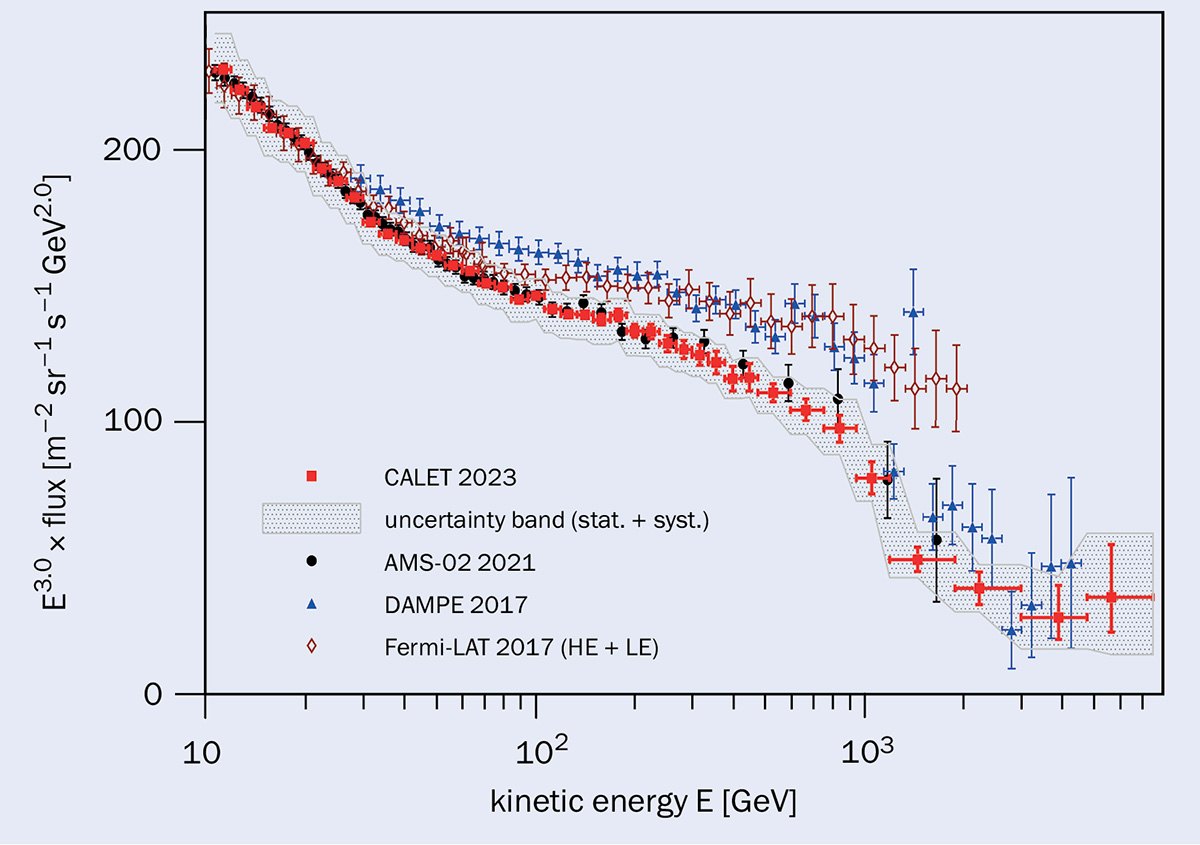
The discovery marks a major leap in astrophysics. For over a century, the origin and behavior of cosmic rays have puzzled scientists. Now, the DAMPE space telescope has revealed a consistent “spectral softening” pattern at around 15 teraelectron-volts (TeV) rigidity—a threshold where particle counts drop sharply. This same strange cosmic pattern holds true for multiple particle types, strongly supporting the long-debated “rigidity-dependent” model of cosmic ray transport.
What Are Cosmic Rays? The Universe’s Most Energetic Messengers
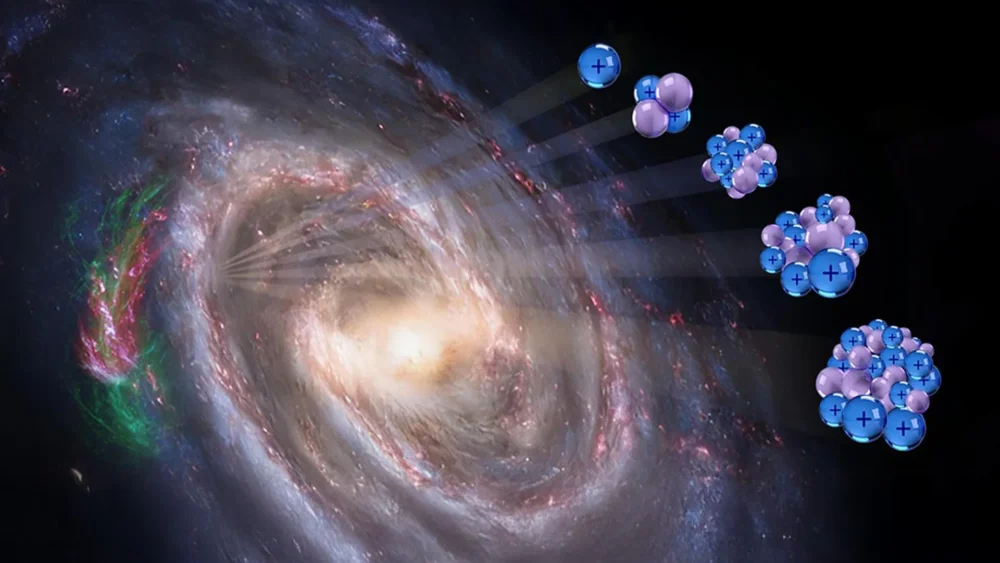
Cosmic rays are charged particles—mostly protons, but also helium, carbon, oxygen, and iron nuclei—zipping through space at nearly the speed of light. They originate from violent events like supernova explosions, pulsar winds, and black hole jets. When they smash into Earth’s atmosphere, they create cascades of secondary particles that detectors on the ground and in space can study.
Despite their name, cosmic rays aren’t “rays” like light—they’re atomic nuclei stripped of electrons. Their extreme energies make them key to understanding the universe’s most powerful accelerators. Yet, for 114 years, one big question remained: What universal rules govern their acceleration and journey across interstellar space?
The 114-Year Mystery: Why Scientists Have Searched Since 1912
In 1912, physicist Victor Hess discovered cosmic rays during a high-altitude balloon flight, proving they come from outer space rather than Earth. Since then, astronomers have debated their sources and propagation. Early models suggested particles followed energy-per-nucleon rules, but data never quite fit perfectly.
Decades of ground-based and balloon experiments hinted at patterns, but lacked the precision for heavy nuclei at high energies. The strange cosmic pattern in recent DAMPE data changes that. It shows the same sharp drop-off (called spectral softening) at ~15 TV rigidity across protons, helium, and heavier elements like iron.

This consistency is groundbreaking. As co-author Andrii Tykhonov from the University of Geneva explained: “Cosmic rays are primarily composed of protons, but also of helium, carbon, oxygen, and iron nuclei. These particles are also categorised according to their energy: low, up to a few billion electron-volts; intermediate, from a few billion to several hundred billion electron-volts; and high, from 1,000 billion electron-volts and beyond.”
How the DAMPE Space Telescope Made the Discovery
Launched in December 2015, the DAMPE telescope—also known as the Dark Matter Particle Explorer or “Wukong”—orbits Earth and precisely measures cosmic ray electrons, positrons, protons, and nuclei. Its Silicon-Tungsten Tracker reconstructs particle trajectories and charges with unmatched accuracy.

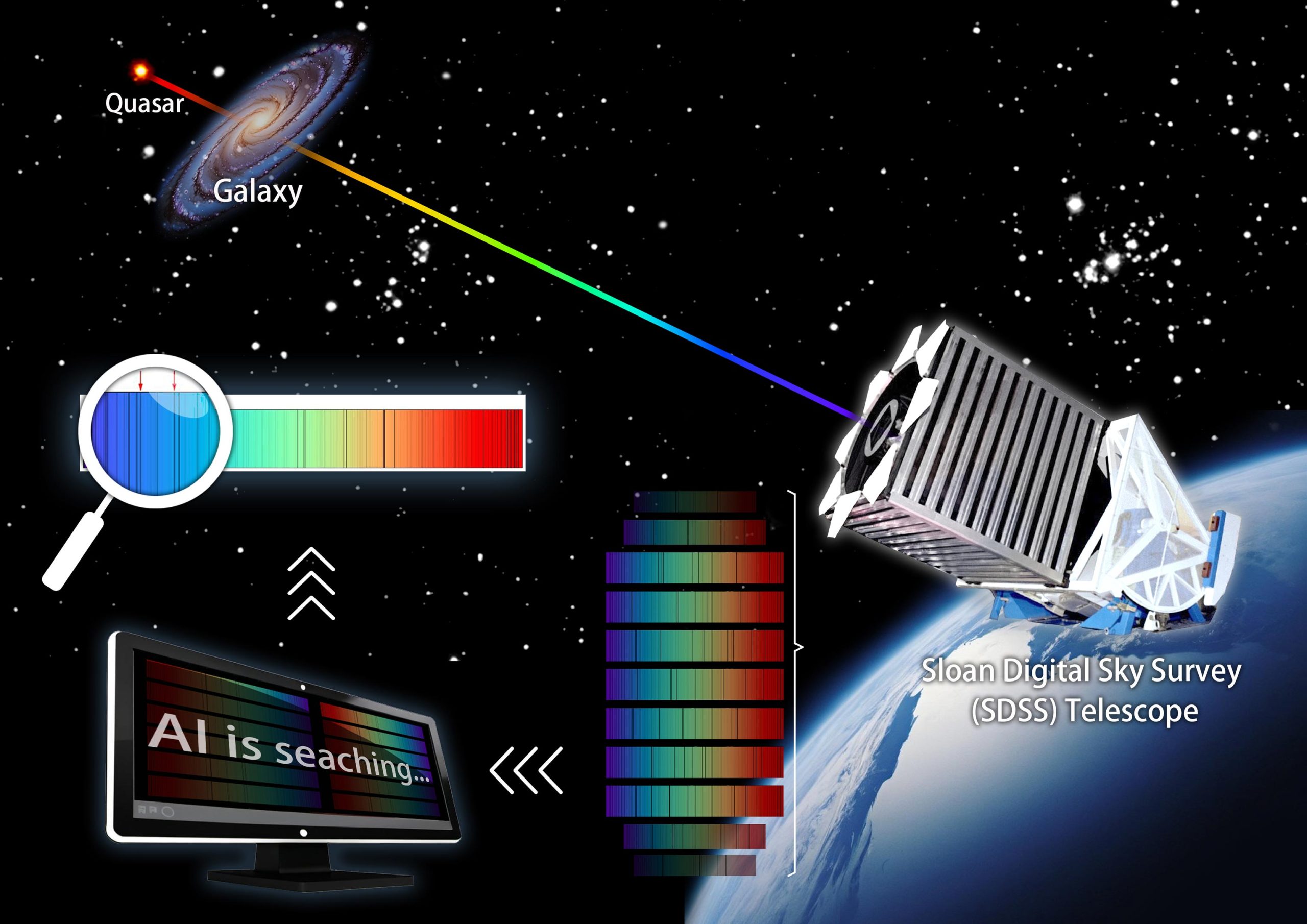
Researchers applied advanced artificial intelligence techniques to reconstruct millions of particle events. The AI helped filter noise and reveal the hidden pattern with 99.999% statistical confidence—ruling out older energy-per-nucleon models.
The results strongly favor rigidity (a measure of how much magnetic fields bend charged particles) as the key factor shaping cosmic ray spectra. This has huge implications for models of particle acceleration in supernova shocks and galactic magnetic fields.
What This Strange Cosmic Pattern Means for Astrophysics
- Unified Physics Rule: The identical softening across light and heavy nuclei suggests a single mechanism governs cosmic ray behavior galaxy-wide.
- Better Models of Acceleration: It tightens limits on how supernovae, pulsars, and black holes boost particles to extreme energies.
- Dark Matter Insights: While DAMPE’s primary goal involves dark matter searches, this cosmic ray data refines background signals for future exotic particle hunts.
- Interstellar Transport: Magnetic fields and turbulence in the Milky Way now have clearer constraints.
This isn’t just another data point—it’s the strongest evidence yet for a universal cosmic ray “rulebook.”
Future of Cosmic Ray Research: What’s Next?
The DAMPE discovery opens doors for next-generation missions like upgraded AMS-02 on the ISS, CALET, and future space telescopes. Combined with AI-driven analysis, scientists expect even sharper insights into the universe’s most energetic phenomena.
As data pours in, the strange cosmic pattern detected by this space telescope could rewrite textbooks on high-energy astrophysics. A 114-year mystery may finally be cracking open.
What do you think this means for our understanding of the cosmos? Share your thoughts below—and don’t forget to follow for more groundbreaking space discoveries like this DAMPE cosmic ray breakthrough!