









Imagine watching a massive exoplanet race around its star every 8.25 days — only to suddenly disappear from view in early 2026. That’s exactly what happened with TOI-2535b, a hot Jupiter first spotted by NASA’s TESS in 2019. For seven years, astronomers tracked its transits with clockwork precision. Then? The planet’s apparent path slowly shifted toward the star’s edge until its transits vanished completely.
In this breaking-down of the disappearing exoplanet phenomenon, we reveal what astronomers actually found: the planet didn’t vanish into space — its orbit tilted due to gravitational influence from a hidden companion. This groundbreaking observation, published in the Astrophysical Journal Letters, is the first time scientists have directly watched an exoplanet’s transits disappear around a single star. It’s a cosmic “vanishing act” powered by orbital precession and mean-motion resonance.
The Giant Planet That Slowly Slipped Out of Sight
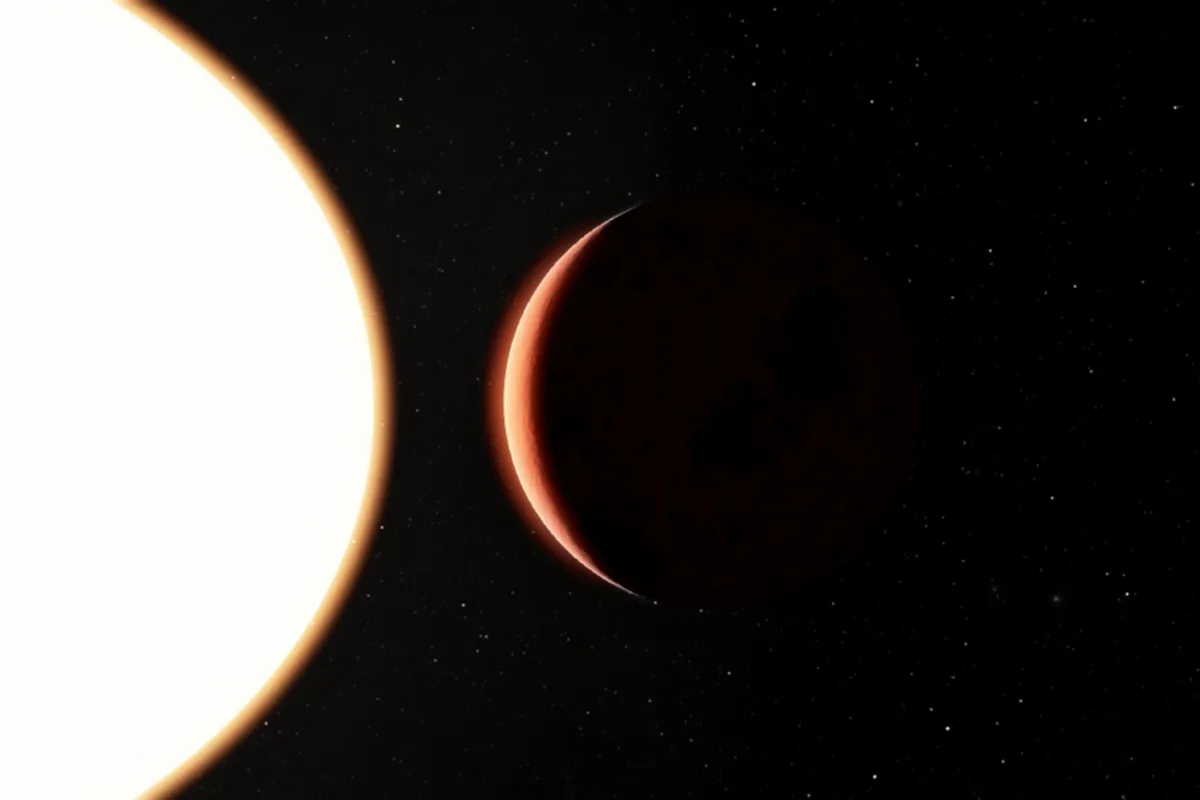
TOI-2535b orbits an old, early K-type dwarf star about 1,000 light-years away in the constellation Corvus. The planet is a classic hot Jupiter — a massive gas giant racing so close to its star it completes an orbit every 8.25 days (faster than Mercury).
When TESS first observed the system in 2019, the planet crossed the star’s face directly, producing a clean, deep transit signal. But over the next seven years, something strange unfolded. The planet’s path moved closer and closer to the star’s edge. What began as a central transit gradually turned into a grazing transit.
The impact parameter — the distance from the star’s center — changed at a blistering 0.16 per year, the fastest recorded shift for any exoplanet around a single star. By early 2026, TESS could no longer detect any crossing. The disappearing exoplanet wasn’t gone; its orbital orientation had simply changed enough to move its path out of Earth’s line of sight.
The Strange Six-Hour Timing Mystery
Even stranger: the transits weren’t perfectly regular. Some appeared up to six hours away from their expected times — among the largest timing variations ever seen for a hot Jupiter.
Using the NEID spectrograph on the WIYN 3.5-meter telescope at Kitt Peak National Observatory, astronomers (led by UCLA’s Samuel Yee) dug deeper. The data revealed gravitational tugs from an unseen companion planet. This hidden world could be Saturn-mass or larger. The two planets likely orbit in a mean-motion resonance (period ratios near 2:1 or 3:2) and their orbital planes are tilted by at least 5 degrees.
This setup triggers orbital precession — a slow wobble of the orbital planes, similar to a spinning top. Over decades, the tilt gradually carried the planet’s path out of view, making its transits disappear.
Visual of orbital precession and mean-motion resonance in action
What the Vanishing Transits Reveal About Hot Jupiter Formation
Hot Jupiters like TOI-2535b orbit stars at blistering speeds and have baffled astronomers for years. Two main theories explain how they end up so close:
- Violent high-eccentricity migration — a planet gets flung inward through gravitational chaos.
- Gentle disk migration — a planet slowly spirals in through the gas-rich disk surrounding its young star.
The discovery of this disappearing exoplanet favors the second scenario. The suspected companion planet makes TOI-2535b one of the rare cases where a hot Jupiter shares its neighborhood with another giant planet. Dr. Yee explained: “Because TOI-2535b has a close neighbor, it probably migrated by slowly spiraling in instead of getting flung in. We may be seeing a formation channel that doesn’t happen very often but is very interesting.”
The second planet remains unconfirmed, but the observations have already captured something never before seen: a giant exoplanet’s transits disappearing over just a few years.
Why This Matters for Astronomy
This TOI-2535b vanishing act is more than a cool headline — it’s a rare window into how planetary systems actually form and evolve. The disappearing exoplanet mystery highlights the power of long-term TESS monitoring combined with ground-based follow-up. It also shows how even the most dramatic observations can reveal hidden worlds through subtle gravitational dances.
Astronomers will continue watching. Future TESS data, combined with radial velocity measurements and Gaia astrometry, may finally confirm that second planet and answer one of the biggest questions in exoplanet science: How do hot Jupiters really get so close to their stars?
Key Takeaways:
- TOI-2535b is the first confirmed disappearing exoplanet whose transits vanished around a single star.
- The culprit: orbital precession driven by a hidden companion.
- This discovery strongly supports gentle disk migration over violent scattering.
- Published in the Astrophysical Journal Letters — full paper available via the University of California, Los Angeles team.
If you’re fascinated by exoplanets, hot Jupiters, transiting exoplanets, or orbital dynamics, this disappearing exoplanet story is one you won’t want to miss. Bookmark this page, share with fellow stargazers, and stay tuned for updates on the hunt for that second hidden world.