








🚀 Introduction: A Cosmic Question Everyone Asks
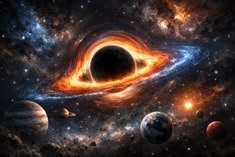
Black holes are among the most mysterious objects in the universe. Naturally, many people wonder: What would happen if a black hole entered our solar system?
While it may sound like science fiction, scientists from organizations like NASA have studied this possibility in detail through simulations, gravitational modeling, and observations of black hole behaviors elsewhere in the galaxy.
In this article, we will explore the relationship between black holes and our solar system, separate facts from myths, and explain what science really says.

🌑 What Is a Black Hole?

A black hole is a region in space where gravity is so strong that nothing not even light can escape.
This happens because of an extreme concentration of mass in a very small area, creating what scientists call a gravitational singularity. Black holes form primarily from the collapse of massive stars after they exhaust their nuclear fuel in a supernova explosion. There are also supermassive black holes at the centers of most galaxies, including our Milky Way, and theoretical primordial black holes from the early universe.
👉 In simple terms: A black hole acts like a “cosic vacuum,” but not in the way movies often show. It doesn’t actively “suck” things from far away its gravity follows the same laws as any other massive object, but becomes overwhelmingly intense only at close range.
☀️ Understanding Our Solar System

Before diving deeper, let’s briefly understand the structure of our solar system.
The Solar System consists of:
- The Sun
- Eight planets, including Earth
- Moons, asteroids, and comets
👉 Everything is held together by the Sun’s gravity. The Sun contains about 99.8% of the total mass in the solar system, dominating the gravitational dynamics. Planets, asteroids, and comets follow stable orbits shaped over billions of years. Any significant external gravitational influence could perturb these delicate balances.
🧲 How Powerful Is a Black Hole?

To understand the impact, we need to look at gravity: F=Gm1m2r2 F = \frac{G m_1 m_2}{r^2}
This equation shows that gravitational force increases with mass and decreases with distance (following an inverse square law).
👉 Key insight: A black hole only becomes dangerous if it gets very close. For example, a stellar-mass black hole (5–20 times the Sun’s mass) would need to pass within a few astronomical units (AU) to cause major disruptions, while its event horizon—the point of no return—might be just a few dozen kilometers across. Farther away, its effects would be subtle, similar to those of any other massive object at the same distance.
🌠 What If a Black Hole Entered Our Solar System?

1. It Would Not “Suck Everything Instantly”
- Contrary to popular belief, a black hole wouldn’t immediately swallow the entire solar system.
In fact, if the Sun were replaced by a black hole of the same mass:
- Earth would continue orbiting normally
- There would be no sudden destruction
👉 However, there would be no sunlight, which would freeze the planet over time. Without the Sun’s heat and light, Earth’s surface temperatures would plummet rapidly. Within days, oceans would begin to freeze, and photosynthesis would stop, leading to the collapse of most ecosystems within weeks to months. The atmosphere itself would eventually freeze onto the surface over longer periods. NASA confirms that planetary orbits would remain unchanged because gravity depends on mass, not the object’s size or luminosity time.
2. Gravitational Disruption Would Be the Real Threat
- If a black hole passed nearby:
- Planetary orbits could shift
- Asteroids might be pulled inward
- Chaos in the solar system could begin
👉 This is the most realistic danger scenario. A stellar-mass black hole passing through the outer solar system (e.g., near the Oort Cloud) could fling comets and asteroids toward the inner planets, increasing impact risks. Closer approaches (within 100 AU) could noticeably alter the orbits of outer planets like Uranus and Neptune, potentially leading to long-term instabilities, collisions, or ejections of planets from the system.
3. Tidal Forces Could Tear Objects Apart
When objects get too close, they experience extreme stretching called spaghettification.
- Gravity pulls harder on one side than the other
- Objects can be torn apart at the atomic level
Tidal forces arise because the gravitational pull is stronger on the near side of an object than the far side. For a small stellar black hole, these forces become extreme well before the event horizon, stretching objects vertically and compressing them horizontally—like turning a planet or spacecraft into a long, thin stream of matter. Stephen Hawking popularized this concept, describing how an astronaut would be stretched like spaghetti. Larger supermassive black holes have gentler tidal forces near their horizons, allowing objects to cross relatively intact before being destroyed deeper inside.
🌌 Could This Actually Happen?
The good news is: It’s extremely unlikely.
According to European Space Agency:
- There are no known black holes near our solar system
- Space distances are vast and mostly empty
- Orbital paths are stable
The nearest confirmed black hole, Gaia BH1, is about 1,560 light-years away—far too distant to pose any threat. Isolated stellar black holes might exist as close as 80–100 light-years on average statistically, but encounters remain extraordinarily rare due to the immense emptiness of space. Our solar system has remained stable for over 4 billion years without such disruptions.
👉 In other words, we are safe.
🔭 What Scientists Are Studying Right Now

Even though the risk is low, black holes remain a major focus in astronomy.
Recent discoveries include:
- Imaging of black holes by Event Horizon Telescope (notably M87* and Sagittarius A*)
- Study of gravitational waves detected by LIGO/Virgo from black hole mergers
- Understanding galaxy formation and the role of supermassive black holes in regulating star formation
👉 These studies help us understand the universe better. Ongoing missions and telescopes continue to probe black hole properties, accretion disks, jets, and their mergers, providing insights into extreme gravity and fundamental physics.
🌍 Why Black Holes Matter to Us

Although distant, black holes are important because:
- They shape galaxies by influencing star formation and galactic evolution
- They help scientists test physics theories, including general relativity in extreme conditions
- They reveal how gravity works at extreme levels and may hold clues to unifying gravity with quantum mechanics
Black holes also drive some of the most energetic phenomena in the universe, such as quasars and powerful jets that can extend thousands of light-years.
🧠 Fun Facts About Black Holes

- Some black holes are billions of times heavier than the Sun (supermassive black holes)
- Time slows down near a black hole due to gravitational time dilation—clocks near a black hole tick slower relative to distant observers
- They can emit radiation (Hawking radiation), a theoretical process where black holes slowly lose mass through quantum effects near the event horizon. Over immense timescales, even the largest black holes could eventually evaporate
👉 Yes, black holes are not completely “black”!
- 👉 https://www.nasa.gov (Space research and updates)
- 👉 https://www.esa.int (European Space Agency)
- 👉 https://eventhorizontelescope.org (Black hole imaging research)
🧾 Conclusion: Should We Be Worried?
In conclusion, while the idea of a black hole entering our solar system is fascinating, it is not something we need to worry about.
Instead, black holes help scientists unlock the secrets of the universe.
So rather than fear them, we should see them as cosmic mysteries waiting to be explored.

Thanks for sharing this useful information.
Thank you for your feecback.